


Introduction
Content marketing ideas are the foundation for any good digital marketing strategy. From writing compelling blog posts to taking advantage of social media, powerful content is a force multiplier for brands looking to connect with their audience, establish trust and accelerate long-term growth. In today’s internet race to the top, companies are looking for creative ways to sell more online Content marketing has already proven itself in the marketplace.
No matter if you’re a small business or a high-growth company, the perfect content can help you draw in potential customers, nurture your leads and reinforce your brand. So in this article, let us look at best content marketing ideas to increase brand growth in the digital age.
- Introduction
- Why Is Content Marketing Important for Brand Growth
- What Types of Content Work Best in Digital Marketing?
- How Can Small Businesses Use Content Marketing Effectively?
- How Do You Create a Content Marketing Plan Step by Step?
- What Role Does Social Media Play in Content Marketing?
- How Do You Measure the Success of Content Marketing Campaigns?
- 1. Define Your Goals First
- 2. Track Website Traffic (Quantity & Quality)
- 3. Measure Engagement Metrics
- 4. Monitor Lead Generation & Conversion Rates
- 5. Analyze SEO Performance
- 6. Evaluate ROI (Return on Investment)
- 7. Use Attribution Models
- 8. Collect Customer Feedback & Social Proof
- 9. Benchmark Against Competitors
- 10. Review and Refine Regularly
- FAQ's
- Conclusion
Why Is Content Marketing Important for Brand Growth
Content marketing ideas plays the most effective role in building a brand, as it enables businesses to make authentic connections with their customers, establish trust and maintain visibility over time.
With creative content marketing tactics and creative content ideas, brands can differentiate themselves in a crowded digital world. And for startups and small business owners using the right content marketing tips for small businesses means cost-effective growth.
Aawareness of what is happening in the world of digital content marketing and to experiment with new ideas for content creation can make campaigns more interesting. By creating a strong content marketing plan example and making it simple through things like clear content promotion strategies, or effective social media content marketing brands can increase awareness, credibility, and customer loyalty. content marketing trends for updating strategy plans.
What Types of Content Work Best in Digital Marketing?
Selecting the right form of content is a critical aspect of digital marketing, and it could be a resonating factor between engaging your audience and/or increasing conversions. Top brands are using innovative content marketing tactics to attract, engage, and retain their audience. From a blog post or video, right up to infographics and podcasts, the latest craze of content production ideas is letting businesses lead the way against their competitors.
For startups and small business owners, utilizing tips for content marketing for small businesses will guarantee the efficacy of your marketing campaigns while you enjoy cost savings. It can add to reach by adopting digital content marketing styles such as short-form video and interactive posts. Realistic content creation suggestions paired with solid examples from good content marketing plansthey lead to cohesive branding. Then by utilizing social media content marketing and content promotion strategies you can ensure that your message is being hit home, and being had by the right people at the right times.
Content Marketing Ideas That Work Best For Digital Marketing :
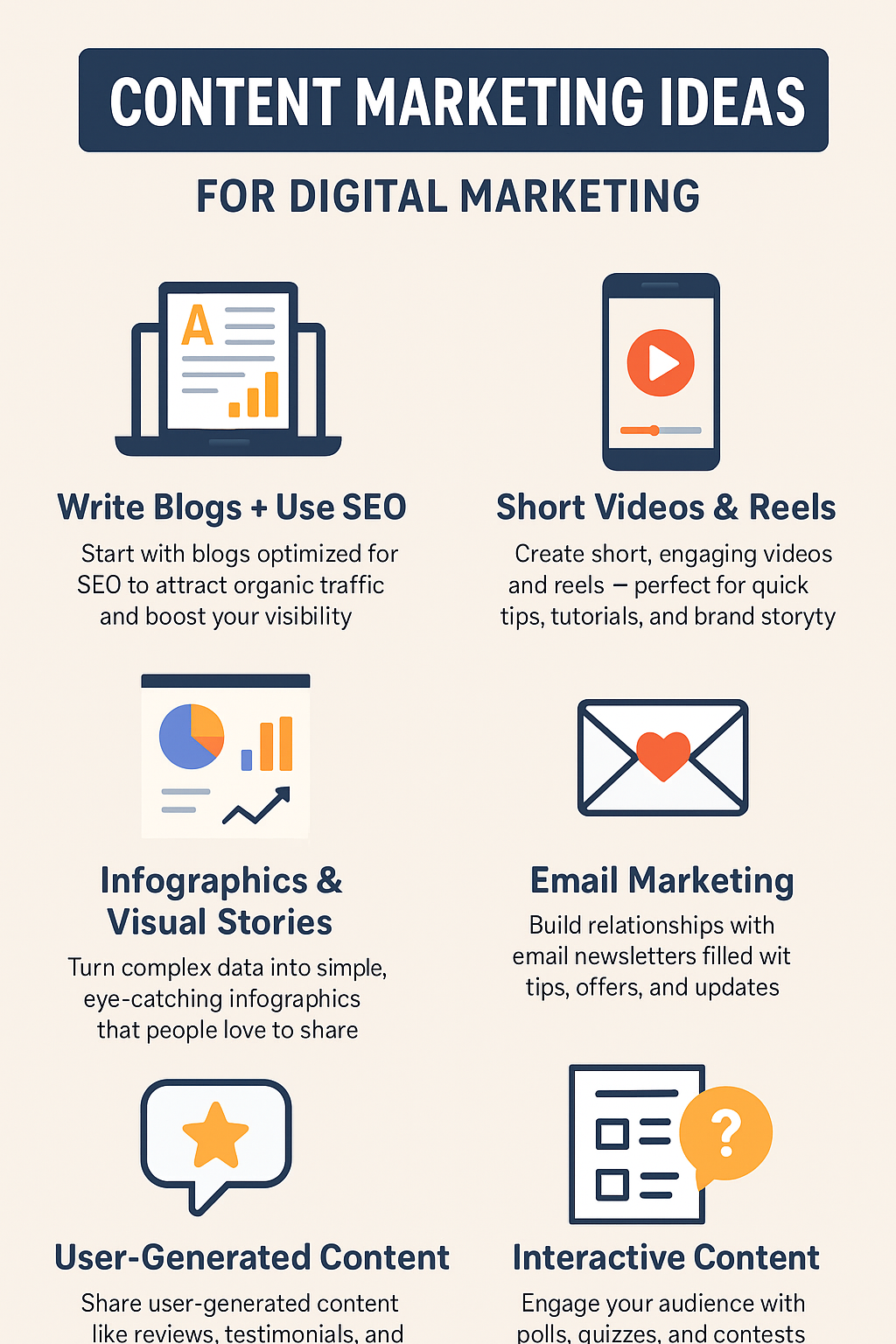
Articles & Blog Posts – Establish authority, drive more SEO traffic and deliver value to your audience.
Videos & Reels – Immersive, shareable, great for storytelling.
All Things Data Related Infographics – Turn Complicated Facts into Eye-Candy!
Posts on Social Media – Like monthly, quick updates and engaging with brand’s audience.
Email Newsletters – Keep prospect warm and customers hot.
Case Studies & Success Stories – Show outcomes and earn trust.
Podcasts & Audio Content – Reach listeners during their daily commute.
E-books & Whitepapers – Share detailed knowledge and capture leads.
User generated Content (UGC)– It promotes trust and builds your community.
Interactive Content (quiz, poll, calculator) – Get your audiences to engage and remember.
How Can Small Businesses Use Content Marketing Effectively?
Content marketing is a transformative strategy, not merely a trend. Its importance can be highlighted in the following ways:
Establishing trust and authority: Providing valuable, relevant content establishes expertise and authority in a niche.
Generating organic traffic: Properly optimized content enhances visibility in search engines.
Contending with larger enterprises: Through well-thought-out marketing approaches, it is possible to garner clientele with little to no advertisement budget.
ILet’s face it — running a small business is hard. You’re battling against bigger brands that have deep pockets, built-in brand recognition and even whole marketing departments behind them. But here’s the good news: Content marketing is the great equalizer. Done properly, it can make small businesses shine, grab committed customers and even beat out larger competitors — all without emptying the piggy bank.
In summary, content marketing enables small businesses to amplify their marketing efforts significantly.
How Do You Create a Content Marketing Plan Step by Step?
1) Align content with business goals
- Define 1–3 clear goals (brand awareness, lead generation, customer retention).
- Tie each goal to measurable KPIs (traffic, leads, sales).
- Note which creative content marketing strategies support each goal (e.g., SEO blog for organic leads; webinars for lead nurture).
2) Audit current content (content inventory)
- List all existing assets (blog posts, videos, social posts, guides).
- Record performance (views, shares, leads, conversion rate).
- Identify gaps where content creation ideas or innovative content ideas are needed.
3) Define your target audience & create buyer personas
- Create 2–4 personas: demographics, goals, pain points, preferred channels.
- Use personas to generate content marketing tips for small businesses that speak directly to real customers.
- Map persona journey stages (awareness → consideration → decision).
4) Do keyword & topic research (SEO + LSI)
- Find high-intent keywords and supporting LSI terms; prioritize long-tail keywords.
- Create a topic-cluster map (pillar page + supporting posts).
- Record content marketing plan examples of pillar content vs. tactical posts.
5) Choose content types & formats
- Decide on a mix: blog posts, case studies, infographics, short-form videos, podcasts, email sequences.
- Match format to audience and goal (e.g., short videos for awareness using social media content marketing).
- Include innovative content ideas like interactive quizzes, user-generated content, or micro-lessons.
6) Map content to the funnel
- Awareness: list formats (short videos, blog guides, social posts).
- Consideration: webinars, case studies, comparison posts.
- Decision: demos, coupons, detailed product pages.
- Ensure each content piece has a clear CTA tied to the funnel stage.
7) Build a content calendar & production workflow
- Create a monthly calendar: content topics, publish dates, owners, promotion windows.
- Define production steps: brief → draft → edit → SEO check → design → publish → promote.
- Use this to scale content creation ideas consistently.
8) Create content briefs & templates
- For each piece include: target persona, goal, keyword(s), headline options, outbound links, CTA.
- Use templates to speed production and keep quality consistent — a top content marketing tip for small businesses.
9) Produce content efficiently (repurpose & batch)
- Batch create: record several short videos in one session, write multiple blog outlines at once.
- Repurpose pillars into social posts, infographics, email snippets — maximizes mileage from one asset.
- Encourage user-generated content to reduce creation time and boost authenticity.
10) Optimize for SEO and readability
- On-page basics: title tag, meta description, H1/H2 structure, alt text, internal links.
- Make content scannable: short paragraphs, bullets, clear headings.
- Use LSI keywords naturally in headings and body copy to support rankability.
11) Plan distribution & content promotion strategies
- Organic: publish on site + share on chosen social platforms (prioritize 1–2 where your audience is).
- Email: promote new content to subscribers with a clear CTA.
- Paid: boost top-performing posts or use targeted ads to reach new audiences.
- Partnerships: guest posts, influencer content, local collaborations.
- Mix is key — this is the operational side of social media content marketing and content promotion strategies.
12) Measure success & define KPIs
- Track metrics by goal: traffic (sessions), engagement (time on page, shares), leads (form fills), conversions (sales).
- Set a reporting cadence (weekly for social, monthly for site content).
- Run A/B tests on headlines, CTAs, thumbnails — continual refinement.
13) Allocate resources & budget
- List who will create, edit, design, and promote content (in-house, freelance, agency).
- Allocate a monthly budget for tools, ads, and outsourced work.
- Prioritize spending on high ROI digital content marketing trends (e.g., short-form video production or paid distribution).
14) Governance, brand voice & approval process
- Create a short style guide (voice, tone, image usage, accessibility).
- Define legal & compliance checks and approval timelines.
- Keep assets stored and named consistently for easy repurposing.
15) Iterate using insights & follow trends
- Quarterly review: what content types and channels delivered most value?
- Adapt to digital content marketing trends (short-form video, personalization, interactive formats).
- Keep a backlog of innovative content ideas to test.
What Role Does Social Media Play in Content Marketing?
Social media plays a vital role in content marketing by amplifying reach, driving traffic, and building authentic customer relationships. From promoting blog posts to creating shareable short-form videos, social platforms help small businesses and brands connect with their audience, boost engagement, and stay relevant with digital content marketing trends. Discover how social media content marketing strengthens your overall strategy and turns followers into loyal customers.
How Do You Measure the Success of Content Marketing Campaigns?
Creating content is only half the job—the real question is: is it working? Measuring the success of your content marketing campaigns ensures you’re not just publishing blindly but actually moving closer to your business goals. Here’s how to track and measure success step by step.
1. Define Your Goals First
Before tracking, be clear on what success looks like. Common content marketing goals include:
- Increasing brand awareness
- Driving website traffic
- Generating leads or sales
- Boosting customer engagement
- Improving customer retention
2. Track Website Traffic (Quantity & Quality)
- Use Google Analytics or similar tools to measure visits, page views, and traffic sources.
- Pay attention to organic traffic—an indicator of strong SEO.
- Track bounce rate and time on page to see if your content keeps people engaged.
3. Measure Engagement Metrics
Engagement shows whether people actually interact with your content. Look at:
- Likes, shares, and comments on social media
- Average session duration on blogs or videos
- Scroll depth (how far users read down a page)
- Email open and click-through rates
4. Monitor Lead Generation & Conversion Rates
If your goal is sales or sign-ups, track:
- Form submissions and newsletter sign-ups
- Free trial requests or demo bookings
- Sales conversions tied to specific content (via tracking links or CRM data)
- Conversion Rate Optimization (CRO) results from CTAs within your content
5. Analyze SEO Performance
- Monitor keyword rankings for your blog posts and landing pages.
- Track backlinks earned from high-quality sites.
- Measure impressions and clicks in Google Search Console.
- Strong SEO performance indicates content is driving long-term results.
6. Evaluate ROI (Return on Investment)
- Compare the cost of producing and promoting content (tools, freelancers, ads) to the revenue or leads generated.
- A positive ROI means your campaign is paying off.
- If ROI is low, adjust distribution or messaging.
7. Use Attribution Models
- Multi-touch attribution shows how different pieces of content contribute to conversions.
- Example: a blog post might start the customer journey, while an email newsletter closes the deal.
- Attribution helps you see the bigger picture of how content works together.
8. Collect Customer Feedback & Social Proof
- Reviews, testimonials, and user-generated content give qualitative insights.
- Polls, surveys, and social media comments reveal what your audience values.
- Feedback complements hard metrics by showing why content works.
9. Benchmark Against Competitors
- Use tools like SEMrush or Ahrefs to compare your performance with competitors.
- Track social media share-of-voice to see if your brand conversation is growing.
- Competitive benchmarking shows where you stand in your niche.
10. Review and Refine Regularly
- Set monthly or quarterly reporting cycles.
- Double down on high-performing formats (blogs, videos, or infographics).
- Cut or improve underperforming campaigns.
FAQ’s
Conclusion
Measuring the success of content marketing campaigns is all about aligning metrics with your goals. Whether it’s traffic, engagement, leads, or sales, the key is to track consistently, analyze insights, and refine your strategy. Remember: what gets measured, gets improved.

