

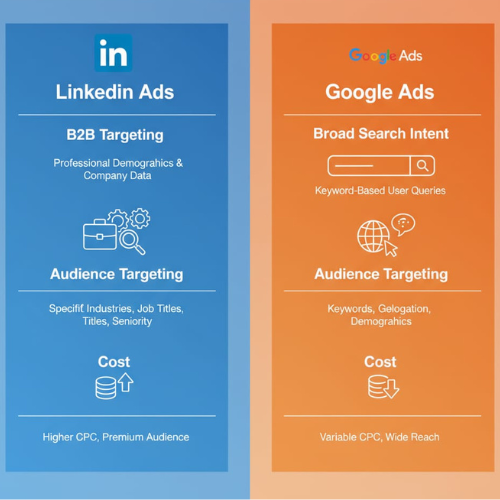
LinkedIn Ads vs Google Ads for B2B plays a crucial role in helping marketers reach decision-makers in today’s fast-changing business landscape. These two powerful platforms often leave businesses wondering which delivers better results. While Google Ads captures active search intent, LinkedIn Ads excels at professional targeting. So, which platform works best for your B2B campaigns? Let’s break it down.
- 1.Why Paid Advertising Matters for B2B Businesses
- 2. Overview of Google Ads
- 3. Overview of LinkedIn Ads
- 4.Targeting Capabilities: LinkedIn Ads vs Google Ads
- 5.Cost Comparison for B2B Advertising
- 6.Lead Quality & Conversion Rates
- 7.ROI Analysis: Which Platform Performs Better?
- 8.When to Use LinkedIn Ads for B2B Marketing
- 9.When to Use Google Ads for B2B Marketing
- 10.Key Differences at a Glance (Comparison Table)
- 11.Final Verdict: Choosing the Right Platform for Your B2B Strategy
1.Why Paid Advertising Matters for B2B Businesses
LinkedIn Ads vs Google Ads for B2B is a crucial consideration for companies in today’s competitive digital landscape. B2B businesses can no longer rely solely on organic reach to connect with decision-makers. Paid advertising helps generate high-quality leads, build brand visibility, and drive measurable ROI.
Google Ads captures active search intent, while LinkedIn Ads provides unmatched professional targeting. By leveraging these paid campaigns, B2B marketers can enhance lead generation ads, run tailored PPC campaigns for B2B, and ensure their brand stands out in the crowded digital marketplace.
2. Overview of Google Ads
When analyzing LinkedIn Ads vs Google Ads for B2B, it’s important to understand how Google Ads works and why it remains a powerful tool for B2B companies. Google Ads allows businesses to target users based on search intent, meaning your ads appear when potential clients actively look for products or services related to your business.
This makes it an effective platform for B2B lead generation ads and high-intent PPC campaigns for B2B. With precise keyword targeting, remarketing options, and measurable performance tracking, Google Ads helps B2B marketers reach decision-makers at the right time, driving qualified traffic and conversions.
Strengths of Google Ads for B2B
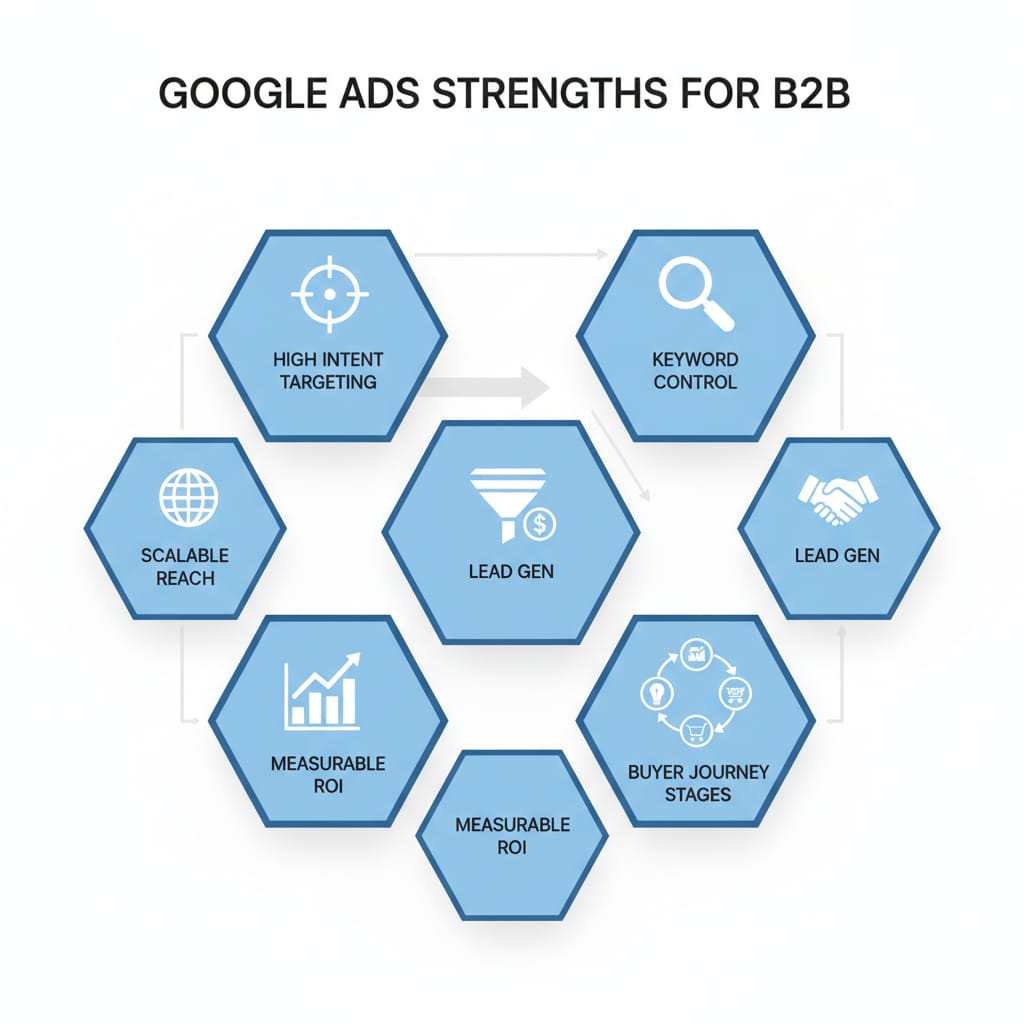
When comparing LinkedIn Ads vs Google Ads for B2B, one of the biggest strengths of Google Ads is its ability to capture high-intent leads. Since B2B buyers often start their journey on Google, running PPC campaigns for B2B ensures your business is visible right when potential clients are searching for solutions.
Google Ads provides advanced keyword targeting, remarketing, and audience segmentation, making it easier to connect with decision-makers actively seeking products or services. This helps businesses drive B2B lead generation ads, improve brand visibility, and achieve measurable ROI. For companies aiming to scale quickly, Google Ads delivers consistent, intent-driven traffic.
Limitations of Google Ads for B2B
While analyzing LinkedIn Ads vs Google Ads for B2B, it’s clear that Google Ads has its own set of limitations for business-to-business marketing. One major drawback is the high competition and rising cost-per-click (CPC) in niche B2B industries, which can make lead acquisition expensive.
Unlike LinkedIn marketing for B2B, Google Ads lacks professional filters such as job title, company size, or industry, making precise targeting of decision-makers more challenging. Many B2B buyers also have a longer sales cycle, so relying solely on PPC campaigns for B2B may not deliver immediate conversions. Without strong remarketing strategies, businesses risk paying more for low-quality or irrelevant clicks.
3. Overview of LinkedIn Ads
When comparing LinkedIn Ads vs Google Ads for B2B, LinkedIn stands out as the world’s largest professional networking platform, making it highly effective for reaching business decision-makers. LinkedIn marketing for B2B allows advertisers to target audiences based on job title, industry, company size, and seniority—features that are unmatched by other platforms.
This makes it ideal for B2B lead generation ads, nurturing prospects, and running paid ads for business-to-business campaigns with precision. By leveraging LinkedIn’s advanced targeting, B2B marketers can engage directly with professionals who have the authority to influence or make purchase decisions, ensuring higher-quality leads and stronger ROI.
Strengths of LinkedIn Ads for B2B
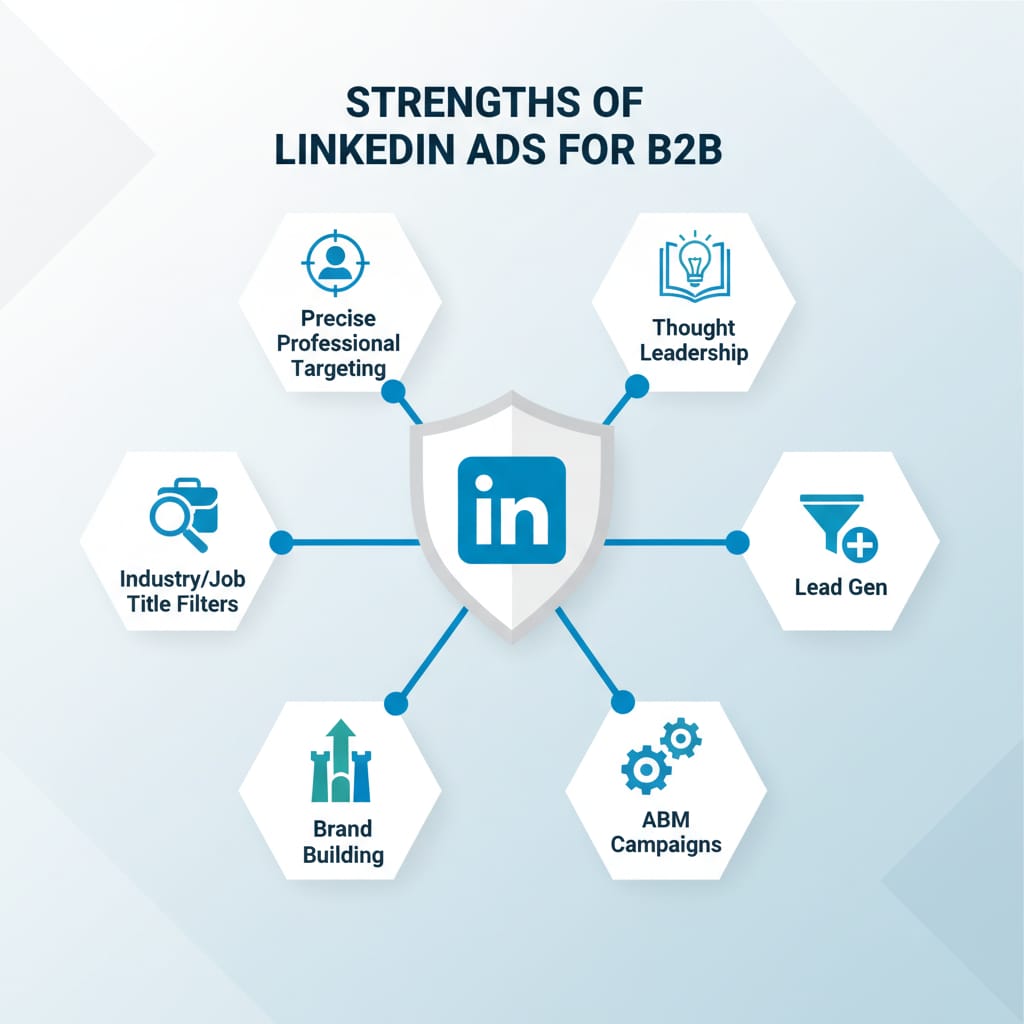
In the debate of LinkedIn Ads vs Google Ads for B2B, one of the strongest advantages of LinkedIn lies in its ability to precisely target professionals and decision-makers. Unlike traditional PPC campaigns for B2B, LinkedIn allows advertisers to filter audiences by job title, company size, seniority, and industry—making it a powerful platform for B2B lead generation ads.
This professional targeting ensures that marketing budgets are spent on high-quality prospects who are more likely to convert. Additionally, LinkedIn’s ad formats, such as Sponsored Content and InMail, support personalized engagement, helping brands build trust, authority, and long-term relationships in the B2B advertising space.
Limitations of LinkedIn Ads for B2B
When comparing LinkedIn Ads vs Google Ads for B2B, it’s important to note that LinkedIn also comes with certain limitations. The biggest challenge for businesses is the higher cost-per-click (CPC) compared to other platforms, which can make PPC campaigns for B2B expensive, especially for startups or small enterprises.
While LinkedIn marketing for B2B provides excellent targeting options, its audience size is smaller than Google’s search network, which can limit campaign reach. Additionally, LinkedIn users may not always be in an active buying mindset, making B2B lead generation ads more focused on brand awareness and nurturing rather than quick conversions.
4.Targeting Capabilities: LinkedIn Ads vs Google Ads
When evaluating LinkedIn Ads vs Google Ads for B2B, targeting capabilities are a major factor in determining campaign success. LinkedIn marketing for B2B offers unmatched precision with filters such as job title, seniority, company size, and industry—perfect for B2B lead generation ads aimed at decision-makers. This ensures that ads are shown to professionals who have buying power.
On the other hand, Google Ads for B2B companies focuses on search intent, allowing businesses to target users actively looking for solutions through keywords and remarketing strategies. While LinkedIn excels in audience quality, Google Ads provides a broader reach, making both platforms powerful for different stages of the B2B advertising funnel.
5.Cost Comparison for B2B Advertising
When analyzing LinkedIn Ads vs Google Ads for B2B, cost is often a deciding factor for marketers. LinkedIn marketing for B2B generally comes with a higher cost-per-click (CPC), as the platform targets niche audiences like CEOs, managers, and decision-makers. While this means fewer clicks, the B2B lead generation ads on LinkedIn often deliver more qualified leads.
In contrast, Google Ads for B2B companies typically offers a wider reach at varying CPC rates depending on industry keywords. Though Google Ads can be more budget-friendly, intense competition in some sectors may drive costs higher. Ultimately, LinkedIn prioritizes lead quality, while Google Ads focuses on scalability and search-driven visibility.
6.Lead Quality & Conversion Rates
In the discussion of LinkedIn Ads vs Google Ads for B2B, lead quality and conversion rates play a critical role in measuring success. LinkedIn marketing for B2B often delivers higher-quality leads because ads can be targeted to professionals by job title, seniority, and company size—ensuring campaigns reach decision-makers with buying authority. This makes LinkedIn highly effective for B2B lead generation ads focused on long-term sales cycles.
On the other hand, Google Ads for B2B companies tends to capture users with strong search intent, leading to quicker conversions through PPC campaigns for B2B. While Google generates a larger volume of leads, LinkedIn typically offers more qualified prospects with stronger long-term conversion potential.
7.ROI Analysis: Which Platform Performs Better?
When comparing LinkedIn Ads vs Google Ads for B2B, return on investment (ROI) is one of the most important factors to consider. LinkedIn marketing for B2B may involve a higher cost-per-click, but it often delivers stronger ROI through qualified B2B lead generation ads that reach decision-makers directly. This means fewer wasted clicks and higher-quality prospects.
On the other hand, Google Ads for B2B companies can generate a larger volume of leads at varying costs, depending on keyword competition. While Google Ads often provides faster conversions due to strong search intent, LinkedIn Ads tend to produce long-term ROI by nurturing high-value business relationships.
8.When to Use LinkedIn Ads for B2B Marketing
In the comparison of LinkedIn Ads vs Google Ads for B2B, LinkedIn Ads are particularly effective when the goal is to target decision-makers and professionals in specific industries. Use LinkedIn when running B2B lead generation ads for high-value products or services, nurturing long-term relationships, or building brand authority in niche markets.
Its advanced targeting options, such as job title, company size, seniority, and industry, make it ideal for LinkedIn marketing for B2B campaigns focused on quality over quantity. For businesses aiming to reach executives, managers, or specialized professionals, LinkedIn Ads provide highly qualified leads that can drive better ROI over time.
9.When to Use Google Ads for B2B Marketing
In the debate of LinkedIn Ads vs Google Ads for B2B, Google Ads is ideal when your goal is to capture active search intent and reach prospects who are actively looking for solutions. Use Google Ads for PPC campaigns for B2B when you want quick visibility, drive website traffic, and generate leads from professionals searching for specific products or services.
Unlike LinkedIn, Google Ads allows targeting through keywords, remarketing, and search intent, making it suitable for campaigns where volume, scalability, and faster conversions are priorities. For B2B companies aiming to maximize reach and tap into intent-driven audiences, Google Ads delivers measurable results efficiently.
10.Key Differences at a Glance (Comparison Table)
Here’s a comparison table for LinkedIn Ads vs Google Ads for B2B
| Feature / Metric | LinkedIn Ads | Google Ads |
| Best For | Targeting professionals & decision-makers | Capturing high-intent search traffic |
| Targeting Options | Job title, seniority, company size, industry | Keywords, search intent, remarketing, demographics |
| Lead Quality | High-quality, decision-maker leads | Moderate to high, intent-driven leads |
| Cost | Higher CPC, focused audience | Variable CPC, can be more budget-friendly |
| Conversion Speed | Slower, focused on nurturing relationships | Faster, based on active search intent |
| Ad Formats | Sponsored Content, InMail, Video Ads | Search Ads, Display Ads, Remarketing Ads |
| Ideal Goal | Brand authority, lead nurturing, B2B relationship building | Website traffic, immediate conversions, lead generation |
| Audience Size | Smaller, highly targeted | Larger, broader reach |
| ROI Focus | Long-term, high-value prospects | Short to medium-term, volume-driven |
11.Final Verdict: Choosing the Right Platform for Your B2B Strategy
When evaluating LinkedIn Ads vs Google Ads for B2B, the choice depends on your marketing goals and target audience. Use LinkedIn Ads when your priority is reaching decision-makers, executives, and professionals for high-quality B2B lead generation ads, nurturing long-term relationships, and building brand authority in niche markets.
Opt for Google Ads when you want to capture active search intent, drive website traffic, and generate faster conversions through PPC campaigns for B2B. Many successful B2B marketers combine both platforms—leveraging LinkedIn for precise targeting and relationship building, while using Google Ads to reach broader audiences and capture intent-driven leads, maximizing ROI.
12.Conclusion
In the debate of LinkedIn Ads vs Google Ads for B2B, both platforms offer unique advantages depending on your marketing objectives. LinkedIn marketing for B2B excels in reaching decision-makers, delivering high-quality B2B lead generation ads, and nurturing long-term professional relationships.
Meanwhile, Google Ads for B2B companies is ideal for capturing active search intent, driving immediate traffic, and generating measurable leads through PPC campaigns for B2B. By understanding the differences in targeting, cost, lead quality, and ROI, B2B marketers can craft a balanced strategy—often combining both platforms—to maximize reach, engagement, and conversions for sustainable growth.

